More Than a Gift: How Asian Americans Are Rewriting the Language of Generosity
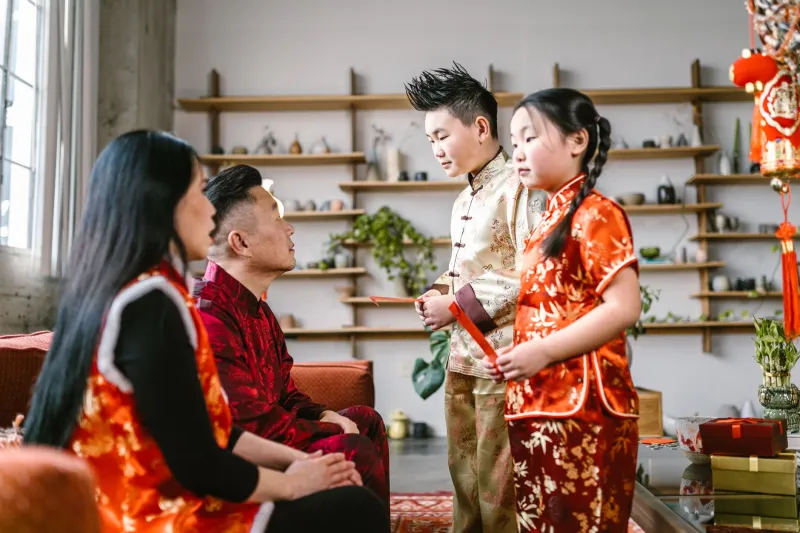
There's a moment a lot of Asian Americans know well. You're at a family gathering, someone hands you something wrapped in red or gold, and before you can even reach for it, the giver waves their hand and says, "It's nothing, it's nothing." Spoiler: it's never nothing.
Gift-giving in Asian cultures operates on a frequency most Americans weren't raised to hear. It's not just about the object — it's about what the object is saying on behalf of someone who might never say it out loud. Love, respect, gratitude, ambition, apology — all of it, folded into a box or tucked inside an envelope. And now, as second and third-generation Asian Americans come into their own economically and culturally, they're not abandoning these traditions. They're remixing them.
The Red Envelope Isn't Going Anywhere
Let's start with the obvious icon. The red envelope — hóngbāo in Mandarin, lì xì in Vietnamese, lihong in Tagalog — is probably the most recognizable symbol of Asian gift-giving in America. During Lunar New Year celebrations from Houston to Honolulu, billions of dollars change hands in these small paper pouches. And yes, billions is the right word. Digital red envelope transactions in the U.S. have surged alongside apps like WeChat Pay, which processed over 46 billion virtual red envelopes during a single Lunar New Year period globally.
But here's what's interesting: younger Asian Americans aren't just continuing the tradition — they're expanding its vocabulary. Some are personalizing digital envelopes with custom messages. Others are using the red envelope format as a template for gifting experiences instead of cash: concert tickets, spa days, cooking classes. The ritual stays intact; the contents evolve.
"I still give my cousins red envelopes, but I'll slip in a handwritten note now," says Michelle T., a 28-year-old Taiwanese American marketing coordinator in Chicago. "My parents never did that. But I wanted it to feel like me, not just a transaction."
The Unspoken Rulebook
Anyone who's grown up in an Asian household knows there's an entire etiquette manual that nobody actually hands you — you just absorb it, usually by watching adults and quietly panicking when you forget a rule.
Don't give clocks (they symbolize death in Chinese tradition). Don't give shoes to a romantic partner (they might walk away). Always bring something when you visit someone's home — never arrive empty-handed. Present gifts with both hands. Don't open gifts immediately in front of the giver — it can come across as greedy.
These aren't arbitrary superstitions. They're a social architecture built over centuries, designed to communicate care without making anyone uncomfortable. In cultures where direct emotional expression can feel exposing, the gift does the emotional heavy lifting.
For many Asian Americans navigating two worlds, these rules can feel like a second language they're still learning to speak fluently — especially when their American friends tear into presents the second they receive them and everyone claps. Neither way is wrong. But the contrast is real.
Luxury as Love Language
Here's something the broader American market is starting to notice: Asian American consumers punch way above their weight in the luxury goods sector. Studies from Bain & Company and McKinsey have consistently flagged Asian American households as disproportionately high spenders on premium brands — and gifting is a major driver of that behavior.
This isn't about showing off. It's about showing up. In many Asian cultural frameworks, the quality of a gift reflects the depth of your regard for the recipient. Giving something cheap to an elder or a close friend isn't frugal — it's a statement, and not a flattering one. So when a second-generation Korean American buys their parents a high-end skincare set for Chuseok, or a Vietnamese American professional gifts their boss a bottle of aged whiskey during Tết, they're operating inside a logic that connects material quality to emotional sincerity.
Luxury brands are catching on. Tiffany & Co., Louis Vuitton, and Gucci have all rolled out Lunar New Year limited editions in recent years, and the response from Asian American consumers has been strong. But younger buyers are getting more selective — they want brands that actually understand the culture, not just slap a dragon on a handbag and call it representation.
When the Traditions Collide
Not everything translates smoothly. Asian American gift-givers often find themselves code-switching between cultural expectations — literally, sometimes at the same event.
Take weddings. At a traditional American wedding, guests bring gifts from a registry. At a Vietnamese or Chinese wedding, guests bring cash in envelopes, often in amounts calibrated to cover the cost of their plate plus a little extra. When an Asian American couple has guests from both worlds at their wedding, the logistics alone can cause low-grade anxiety for months.
And then there's the generational gap within Asian American families themselves. First-generation parents might feel that a heartfelt, expensive gift is the only appropriate expression of love. Their American-raised kids might prefer a thoughtful, inexpensive gesture that feels personal. Neither side is wrong — but the misread can sting.
"My mom spent $300 on a handbag for my birthday and I felt so guilty," admits Jason K., a 31-year-old Filipino American in Los Angeles. "She genuinely thought that's what I wanted. But I would've been just as happy with her cooking me a meal. I didn't know how to tell her that without making her feel like her gift wasn't good enough."
Making It Their Own
What's emerging now is something genuinely new: a generation of Asian Americans who are fluent in the old rules but confident enough to write some new ones. They're keeping the rituals that feel meaningful — the red envelopes, the two-handed presentation, the deliberate thoughtfulness — while shedding the ones that feel performative or anxiety-inducing.
Some are turning to small Asian American-owned businesses for their gifting needs, intentionally looping cultural values into the economics of the gesture. Others are creating new traditions entirely — like a group of friends in New York who started an annual "ancestral gift swap" where everyone brings something that connects to their heritage.
At its core, Asian American gift-giving has always been about one thing: connection. The envelope, the luxury item, the home-cooked meal wrapped in foil and handed over at the door — they're all saying the same thing. I thought about you. You matter to me. Here's proof.
In a culture that sometimes struggles to say those words out loud, that's not a small thing. That's everything.