Who's Got Your Back? How Asian Americans Are Building Mentorship Networks That Actually Work
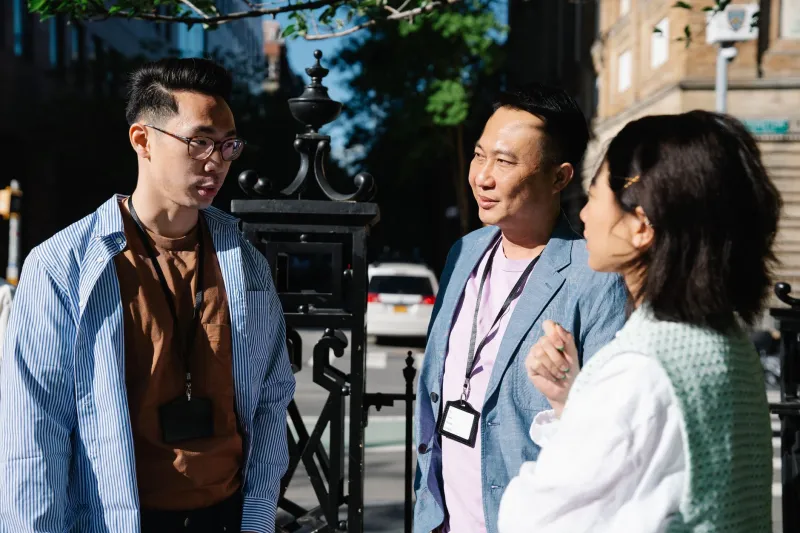
There's a version of mentorship that looks great on paper. You get matched with a senior leader. You have quarterly check-ins. You get added to a few email threads. And then, somewhere around month three, the whole thing quietly fizzles out — and you're left wondering if you imagined the whole arrangement.
For a lot of Asian American professionals, that story sounds painfully familiar. And it's part of why so many of them stopped waiting for corporate programs to save them.
The Mismatch Nobody Talks About
Traditional mentorship models were largely built around a specific kind of professional — one who already had access to the rooms where decisions get made. When those structures get transplanted into diverse workplaces without adjustment, the gaps show up fast.
Research from Catalyst and McKinsey has consistently shown that Asian American employees are among the least likely to be sponsored for leadership roles, even when their performance metrics are strong. The "bamboo ceiling" isn't just about bias in promotion decisions — it's also about who gets pulled aside after a meeting, who gets the quiet heads-up about an opening, who gets the kind of real talk that never makes it into a formal mentoring session.
"A corporate mentor can tell you how to present in a meeting," says one product manager at a Bay Area tech company who asked to remain anonymous. "But they can't always tell you how to navigate being the only Asian person in the room, or how to handle it when your communication style gets labeled 'too quiet' or 'not leadership material.' That's a different conversation."
Building It Themselves
So people started building their own thing. Not always intentionally, and not always with a name attached to it — but organically, in the way that community tends to work.
Affinity groups inside companies became launch pads for something bigger. Asian employee resource groups at places like Google, Microsoft, and Salesforce have long served as gathering points, but over the last several years, the conversations happening inside those groups started spilling outward. People began connecting across companies, across industries, across coasts.
Slack channels turned into group chats turned into standing monthly calls. Someone would share a job posting, someone else would offer to review a resume, a third person would connect the first two with someone they knew at the target company. No formal structure. No application process. Just trust built over time.
Organizations like Ascend, the Asian professional network, and groups like NAPAWF and Gold House have helped formalize some of this energy — but the most potent mentorship often happens in smaller, less visible clusters. A group of six South Asian women engineers who met at a conference in 2019 and have been meeting virtually every other week since. A WhatsApp group of second-generation Vietnamese American business owners in Houston who share vendor contacts and tax advice. A Discord server for Filipino American creatives in New York that functions as part career coach, part therapy session, part job board.
What These Networks Do Differently
The thing that makes community-based mentorship work isn't just shared ethnicity — it's shared context. When you're getting advice from someone who has navigated the same cultural pressures, the same family expectations, the same workplace dynamics, the guidance lands differently.
"My corporate mentor was a great guy, genuinely," says Michelle Tran, a marketing director in Chicago. "But when I told him I was struggling to advocate for myself in salary negotiations because I'd been raised to think asking for more was rude, he kind of looked at me like I was speaking another language. In my community group, everyone got it immediately. And they had actual scripts I could use."
That cultural fluency is hard to replicate in a formal matching program. It shows up in the specifics — how to handle a parent who thinks you should be a doctor, not a startup founder. How to talk about your heritage in a way that reads as an asset rather than a footnote. How to build visibility in a culture that often rewards loudness when your default is precision.
These networks also tend to operate on a pay-it-forward model that feels more sustainable than the transactional mentorship dynamic. The expectation isn't that a senior person dispenses wisdom to a junior person — it's that everyone brings something, and everyone leaves with something. Knowledge moves laterally as much as vertically.
The Leadership Pipeline Nobody Expected
Here's the part that's genuinely surprising: these informal networks are starting to produce results that show up in the numbers.
Professionals who are part of active Asian American affinity or community networks report higher rates of promotion, higher confidence in salary negotiation, and stronger professional networks overall, according to surveys conducted by groups like Lean In and Ascend. The mentorship gap doesn't disappear, but it narrows — because people are filling it themselves.
Some of these networks have also started producing their own leaders in unexpected ways. People who built community groups from scratch have developed facilitation skills, organizational skills, and visibility that translated directly into professional advancement. The community work became the portfolio.
"I never would have been asked to speak on a panel or lead a workshop in my first few years at work," says Kevin Lim, a financial analyst turned fintech founder in Los Angeles. "But through the network I was part of, I was facilitating conversations with fifty people by year two. That changed how I thought about myself as a leader."
What Companies Are (Slowly) Learning
Some organizations are starting to pay attention. A handful of forward-thinking companies have begun integrating community-led mentorship models into their official programming — giving ERGs more resources, creating cross-company mentorship pipelines, and listening when Asian employee groups say the standard mentorship framework isn't working.
But the change is slow, and most professionals aren't waiting around for institutional permission.
The networks are growing. The group chats are active. And somewhere right now, someone is getting the kind of career advice that nobody taught them to expect — not from a corporate program, but from someone who's been exactly where they are.
That's the golden rule these communities figured out on their own: you don't wait to be guided. You find your people, and you build it together.