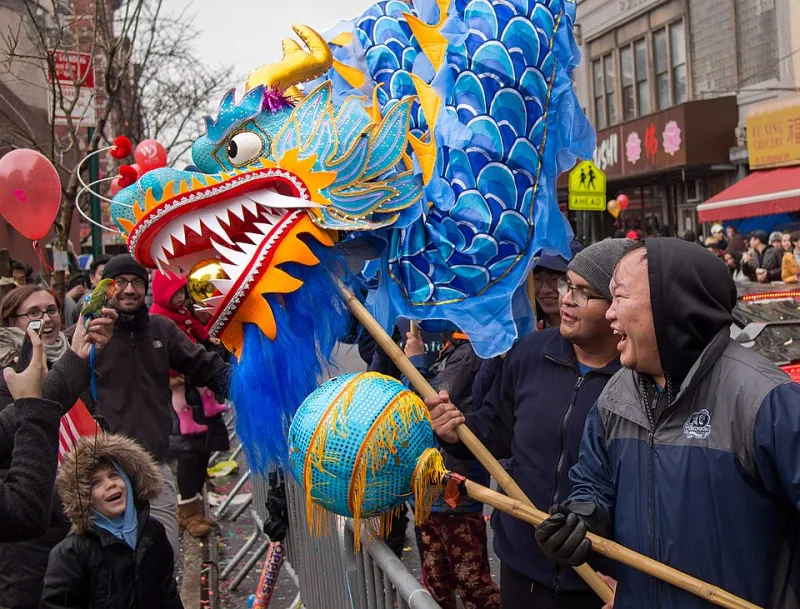
Wait, Which Auntie Is She? A Field Guide to Asian Family Titles (For the Confused and the Curious)
Photo: IPPA photographer, CC BY 4.0, via Wikimedia Commons
So you've been invited to dinner at your partner's house, and you've just been told that the woman bringing the spring rolls is "Auntie Hoa" — except she is not anyone's aunt. Or maybe you're at a Filipino wedding and everyone under 60 is calling somebody "Tita," and you're frantically doing math on the guest list. Breathe. You're going to be fine. And honestly, you're going to end up liking this system more than the one you grew up with.
First, the Big Idea: Everyone Is Family Until Proven Otherwise
In many Asian cultures — Vietnamese, Chinese, Filipino, Korean, Thai, and beyond — you don't call adults by their first names. Ever. Instead, you slot them into family positions. An older woman becomes "auntie" (cô, dì, tita, oba-san, depending on the culture). An older man becomes "uncle." Someone your parents' generation gets a parent-title; someone your grandparents' generation gets a grandparent-title.
The radical part: this applies to strangers. The woman who runs the pho place near your office? Auntie. Your mom's book club friend? Uncle. It's not familiarity — it's a way of saying "you belong to someone." American "Mr. and Mrs." establishes distance. Auntie and Uncle establish a web.
The Cheat Sheet: What to Call Whom
At a Vietnamese table: Cô (coh) for women roughly your parents' age or older-but-not-ancient; chú (choo) for the male equivalent. Bà (bah) for grandmothers and women of that generation; ông (ohng) for grandfathers. When in doubt, aging someone up is polite. Aging someone down is a scandal.
At a Filipino table: Tita (TEE-tah) and Tito (TEE-toh) are the workhorses. Lolo and Lola for grandparents. Everyone at the party will be somebody's Tita. Do not try to map them to actual blood relations — the map doesn't exist and nobody needs it to.
At a Chinese table: The titles encode not just generation but side of the family and birth order. Gūgū, jiějiě, shūshu — there's a whole grammar. You will not master it in one dinner. Nobody expects you to. "Auntie" and "Uncle" with a warm smile carries you remarkably far.
At a Korean table: Ajumma (아줌마) for middle-aged women (use with warmth, not as a blunt instrument), harabeoji and halmeoni for grandfathers and grandmothers. Older siblings and cousins get "unnie," "oppa," "hyung," or "nuna" depending on gender and who's speaking — yes, it's a matrix, and yes, Koreans occasionally have to double-check too.
The Nickname Rules Nobody Wrote Down
Many Asian American families also run a nickname layer. The eldest daughter might be called "Sister" by every cousin younger than her, forever, including at her own wedding. A man everyone calls "Number Two" because he was the second son in a family where sons were numbered — that's his name now. He's 58. It's not negotiable.
There are also the childhood nicknames that survive immigration, translation, and three careers: names that mean "little pig," "chubby," or "egg" in the home language, deployed with total affection in front of your new partner. There is no escape. There is no statute of limitations. Your only defense is that everyone at the table has one too.
For the Confused Partner: Three Survival Tips
- Copy the kids. Whatever the children call someone, that's your answer. Kids have already solved the puzzle.
- When introduced, repeat the title back. "Nice to meet you, Auntie Lan." The slight formality lands as respect, not stiffness.
- Never call an elder by their first name, even if they insist. "Oh, just call me Grace" is a trap with good intentions. Go with "Auntie Grace." Watch her glow.
Why These Titles Actually Matter
Here's my honest opinion, and I'll die on this hill: these titles do something American naming conventions gave up on. "Mr. Johnson" keeps everyone at arm's length until someone grants permission to be closer — and usually, nobody grants it, and you spend twenty years calling your neighbor by his last name.
Auntie and Uncle skip all of that. They say: you are woven into this family's story, right now, no paperwork required. They build in respect for age without making elders feel museum-like. They give kids a hundred relatives they can trust in a crowd. And at a holiday dinner, they quietly organize an entire room of fifty people into one coherent family — including the boyfriend who's never seen any of this before.
So the next time someone hands you a plate and says, "Auntie made too much, eat," understand what just happened. You've been claimed. Eat the spring rolls. That's the whole rule.