Moon Money: The Asian American Entrepreneurs Running Their Businesses on Lunar Time
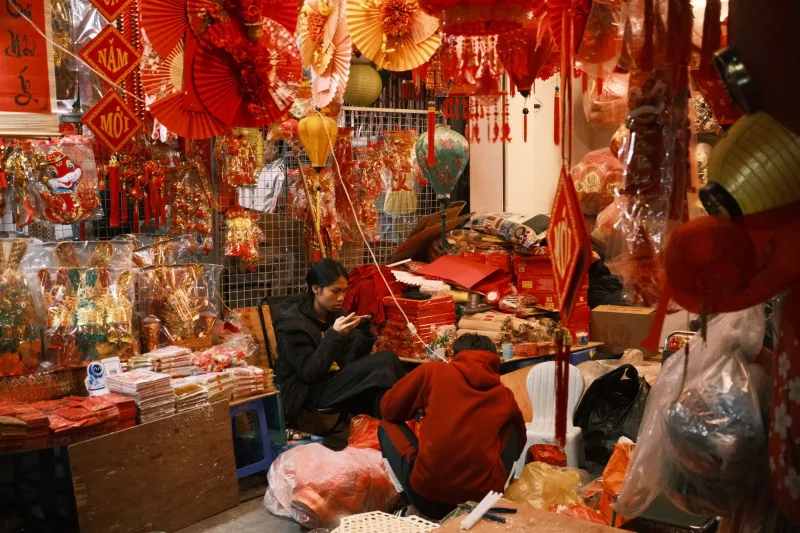
Walk into Lily Chen's San Francisco flower shop in late January and you'll find something that looks, at first glance, like organized chaos. There are kumquat trees stacked three deep near the entrance. Bundles of pussy willow and plum blossom are wrapped in red and gold ribbon. Her staff of four has doubled to eight. The register hasn't stopped ringing since 7 a.m.
Lily isn't just having a good week. She planned this week — down to inventory levels, staffing schedules, and a six-week social media campaign — around a calendar that most of her competitors aren't even tracking. Lunar New Year is her Super Bowl, her Black Friday, and her brand-defining moment all rolled into one. And she's been building toward it since the autumn equinox.
"Most flower shops do Valentine's Day and Mother's Day," she says, wrapping a lucky bamboo arrangement without looking up. "I do those too. But my whole year is organized around the lunar calendar. It's not just a cultural thing. It's a business strategy."
A Different Kind of Business Clock
For centuries, Asian agricultural societies structured their entire year around lunar and solar cycles — knowing when to plant, when to harvest, when to rest, and when to celebrate. These weren't arbitrary traditions. They were sophisticated systems for managing energy, resources, and community across time.
Fast-forward to 2024, and a growing number of Asian American entrepreneurs are finding that these ancient rhythms translate surprisingly well into modern business planning. Not as a gimmick or a niche marketing angle, but as a genuine operational framework that aligns business activity with natural cycles of consumer behavior, cultural energy, and community attention.
The result is a different kind of competitive advantage — one that's hard to replicate if you don't have the cultural fluency to read the calendar correctly.
The Lunar New Year Economy
Let's start with the obvious one. Lunar New Year — celebrated across Chinese, Vietnamese, Korean, and other Asian communities — has become one of the most commercially significant cultural moments in the U.S., with spending that rivals major Western holidays in markets with large Asian American populations.
But the businesses that capture the most value aren't the ones that slap a dragon on their packaging in February. They're the ones that understand the weeks-long arc of preparation, celebration, and gifting that surrounds the holiday — and build campaigns, products, and inventory strategies around that full cycle.
Kevin Tran runs a Vietnamese bakery in Houston that does roughly 30 percent of its annual revenue in the three weeks surrounding Tết. He starts planning in October. "I'm thinking about what flavors are trending, what gift packaging looks premium, what collaborations make sense — all of that has to be locked in months before the holiday," he explains. "By the time January comes, I'm just executing."
Tran has also started building a 'post-Tết' product line — items designed for the quiet weeks after the celebration when customers are still in a reflective, renewal-oriented mindset but the holiday rush has passed. It's a gap most of his competitors ignore entirely.
Seasonal Wisdom as Strategy
Beyond major holidays, some entrepreneurs are going deeper — using traditional seasonal frameworks like the Chinese 24 solar terms or Ayurvedic seasonal principles to guide everything from product development to marketing tone.
Natasha Patel, who runs a wellness brand out of Portland, structures her product launches and content calendar around seasonal transitions rather than Western quarters. "In traditional Ayurvedic practice, each season has a different energy — different needs for the body and mind," she explains. "I design products that speak to those needs and launch them when people are naturally starting to feel that shift."
The result? Her audience, which skews heavily toward South Asian American women and wellness-curious consumers of all backgrounds, engages at consistently higher rates than industry benchmarks. "When you're talking to someone about what they're already feeling in their body, you don't have to work as hard to get their attention," she says.
The Competitive Edge of Cultural Fluency
Here's what makes this more than just savvy niche marketing: the Asian American consumer market is large, growing, and chronically underserved by mainstream brands that treat Lunar New Year as a one-day event and ignore everything else on the traditional calendar.
Businesses that operate fluently in these cultural rhythms aren't just selling products — they're signaling belonging. They're saying: we understand your calendar. We've been thinking about this since before you started thinking about it. That kind of cultural precision builds loyalty that's genuinely hard for outsiders to replicate.
Marcus Liu, who runs a tea import business in New York, has built his entire wholesale pitch around this idea. He educates his retail buyers — many of whom are non-Asian — about the seasonal logic behind traditional Chinese tea consumption: lighter, floral teas in spring; cooling teas in summer; warming, fermented teas in autumn and winter. "I'm not just selling them tea," he says. "I'm selling them a story they can tell their customers. And it's a true story. That's the thing."
When Ancient Meets Algorithm
Of course, running a business on lunar time doesn't mean ignoring modern tools. The entrepreneurs doing this well are layering traditional calendar wisdom onto contemporary digital marketing infrastructure — using the cultural calendar to decide when to push, and data analytics to decide how.
Lily, the San Francisco florist, runs targeted Instagram campaigns that start building awareness of Lunar New Year arrangements in early December — well before most consumers are thinking about it. By the time the holiday is two weeks out, her remarketing audiences are warm and her conversion rates are high. "The traditional calendar tells me the timing. The algorithm tells me the targeting," she says. "They actually work really well together."
More Than Marketing
What strikes you, talking to these entrepreneurs, is that the lunar calendar isn't primarily a marketing tool for them. It's a worldview — a way of understanding time as cyclical rather than linear, of seeing rest and celebration as legitimate parts of a business year rather than interruptions to productivity.
In a business culture that glorifies the relentless grind, there's something quietly radical about building a company that takes the new moon seriously. That closes early on the solstice. That considers what the harvest season means for product design.
It's a different kind of hustle. One that's been refined over thousands of years. And right now, it's paying dividends.